
Every so often, while revisiting an old project, I find myself looking through a time capsule.
Back in 2017, I pulled together a collection of materials I was using during our homeschooling journey. Those lessons eventually became the foundation of my original teaching packet, now my Intro to Roman Religion packet. At the time, it felt complete. It covered the essentials, introduced some of the major Roman deities, and gave young learners a starting point for exploring Roman mythology.
Then, in 2020, I received some constructive feedback that stayed with me. The comment was fair. The resource was a good beginning, but it wasn't quite complete. Then life moved on.
Fast forward to 2026.
Life has changed.
As part of a wider overhaul of my teaching catalogue, I returned to that original packet. Opening the files again felt a little like opening a box in the attic. I could see not only the resource I had created, but also the person who created it.
My children were younger. My business was younger. I was younger too.
Looking back, I could see places where the content needed expanding, refining, and clarifying. More importantly, I could see how much my approach to educational writing had evolved over the years.
I went back to the original sources such as Livy, Varro, and Cicero, fact-checking details and rebuilding sections from the ground up. But the biggest changes weren't confined to the research. I've become increasingly focused on scaffolding.
Time and experience teach lessons that no textbook can provide.
Over the years, I've become much more conscious of including thoughtful supports in my resources. Perhaps that comes from my own past. Perhaps it comes from watching young learners approach challenges in different ways. Either way, I've become more willing to fight for a little extra help when it's needed.
As the revised packet grew, another interesting thing happened.
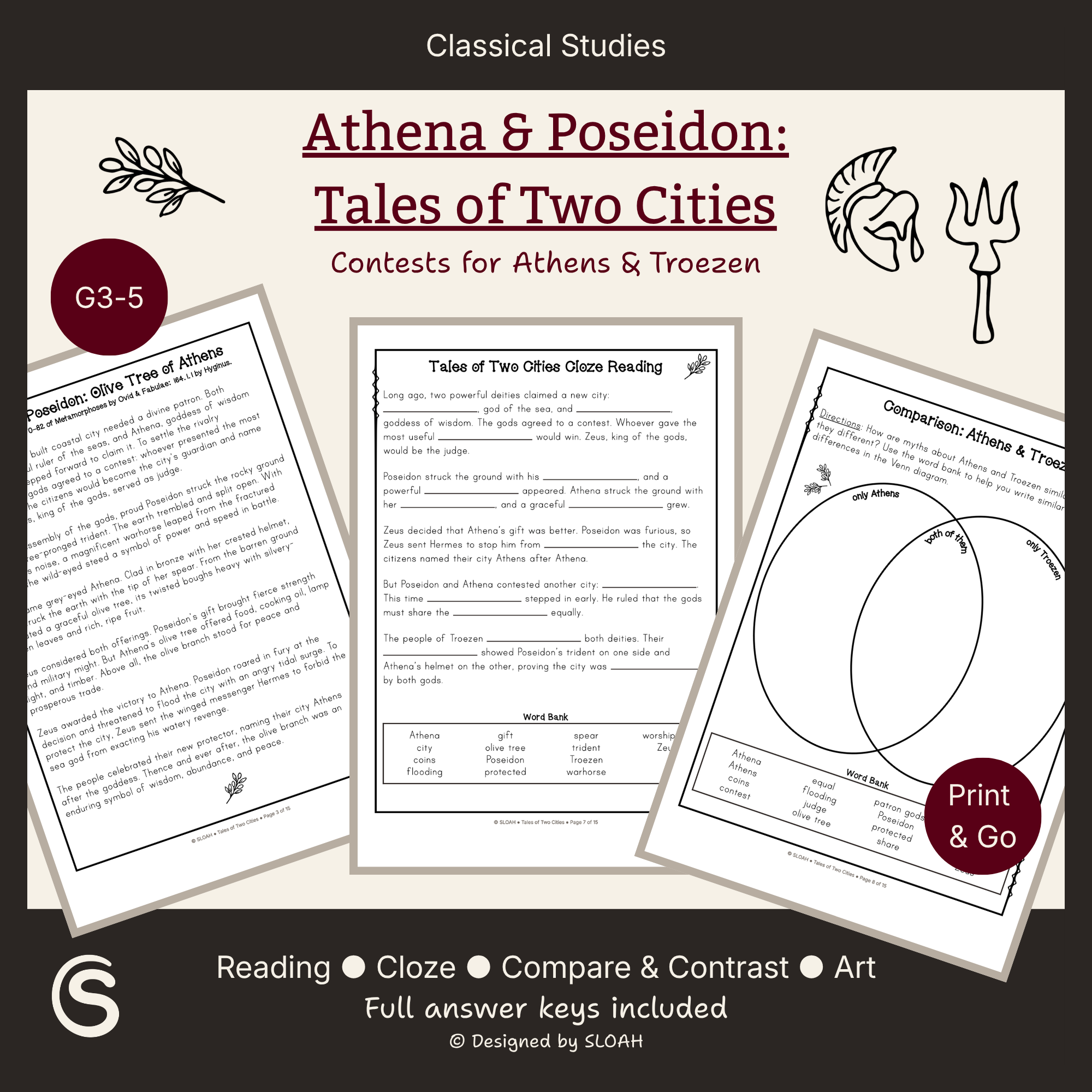
Tucked away inside the original resource was a myth explaining the naming of Athens. It had always been there, but during the revision process it became increasingly clear that it didn't really belong in a general Roman Religion packet. The story was interesting, but it felt like a guest who had wandered into the wrong party.
Rather than squeezing it back into place, I gave it room to grow.
Once separated from the original resource, the Athens story quickly developed into something larger. That eventually led to a companion study exploring the naming of both Athens and Troezen, drawing on the surviving fragments of ancient sources and the traditions recorded by writers such as Pausanias.
In the case of Troezen, the surviving evidence leaves plenty of gaps. Ancient history is often like that. We are left with fragments rather than complete stories. Inspired by the traditions of classical storytelling, I expanded those fragments carefully, building a narrative that supported what is known without contradicting the surviving lore.
What began as a small section of one resource eventually became an entirely new project.
And that may be my favourite part of the whole experience.
Writing has a habit of leading us somewhere unexpected. One question opens the door to another. One story reveals a second story hidden behind it. A revision becomes a rewrite. A rewrite becomes a new resource.
That's how these projects grew, but it's also how learning works.
Curiosity rarely takes us exactly where we planned to go.
More often, it leads us somewhere better.
Comments